Out now · Free on iPhone and Android
A proving ground for the mind.
PhantomBrain is brain training against real people. Four games, the same puzzle for both players at the same moment, and a rating for each.
Three free losses a dayWins and draws never count. Keep winning and keep playing.
Investor or partner? See how PhantomBrain grows
The idea
Brain training, head to head
Brain training with an opponent.
Training alone, you only ever beat your own score. Against a person, every game tells you something, and the ones you lose tell you the most.
Two players get the same puzzle, or the same falling pieces, at the same moment. There are no lucky draws and nothing to buy that helps. The only difference is what’s going on in their heads, and a rating keeps score.
Same game, same moment
Both players get the identical puzzle, piece sequence, wave of problems or chess position. Luck has no say in who wins.
Scored on the server
Every puzzle comes from the server, and every score is worked out there again from the player’s own inputs. The only edge is skill.
Nobody waits
In Grid, Stack and Math, a live opponent when one is online, a real player’s recorded game when not, or a solo game settled against the next five players. A chess puzzle starts at once.
Free plan
All four games · iPhone and Android
Three free losses a day.
On the free plan, only losses count. You can lose three games a day, in any mix of Grid, Stack, Math and Chess Puzzles. Wins and draws are free, so as long as you keep winning, you keep playing.
- GridWonFree
- ChessSolvedFree
- StackLost1 of 3
- MathWonFree
- GridWonFree
- ChessSolvedFree
- MathDrawFree
- ChessMissed2 of 3
- StackWonFree
- MathWonFree
- StackWonFree
- GridLost3 of 3
- All four games, ranked and casual, live and async
- Three losses a day, in any mix of games
- Wins and draws never count
- A loss in a challenge from a Premium member doesn’t count either
- In Chess Puzzles, a missed or peeked Ranked or streak puzzle is one loss, and so is a lost challenge
- No daily limit in any game
- A Premium star next to your name
- Challenges and live rematches you start never cost your opponent a loss
For when three isn’t enough. Subscribe in the app, on iPhone or Android.
Phantom Grid
Memory · Attention · Visualization
Phantom Grid: See it once.
A few shapes sit on a board. Take a good look, because then they’re gone. Moves play out one at a time, some of them decoys, and you put every shape back where it ended.
- 01
Observe
The shapes start in the corners. Memorize them, then hide them.
- 02
Track
Moves appear one at a time, from cell to cell, while nothing visibly moves. Only the last two stay on screen.
- 03
Place
Drag each shape to the cell where it ended, against the clock.
- Levels
- 24, from one shape on a 3×3 board to four shapes on a 5×5, with decoy moves from level 5
- Match
- Up to five rounds on the same puzzles, over as soon as the lead can’t be caught
- Trains
- Visual memory, attention, visualization
Phantom Stack
Memory · Processing · Visualization
Phantom Stack: It’s all in your head.
Falling blocks, except each piece turns invisible as it lands. The stack is still there; you have to remember it, picture it and build on it, fast.
- Pieces never rotate. Flip and Mirror are the only turns.
- Easy hides the last piece to land, Hard the last two, Insanity the last three.
- Landing snug against a hidden block scores Perfect Recall. Clearing a row through hidden blocks scores a Blind Clear, or a Phantom Clear with five or more.
- Game
- Five minutes and the exact same pieces for both players. Highest score wins
- Ratings
- One for each level: Easy, Hard and Insanity
- Trains
- Working memory, pattern recognition, processing speed, visualization
Math
Processing · Memory · Reasoning
Math: Solve it before it lands.
Problems fall toward a base of three panels. Type the answer and fire before each one lands. A wrong answer or a landing costs a panel, and the panels have to last the whole match.
- Fire hits the most urgent problem the answer solves. 0.5 and 1/2 count as the same answer.
- Whole numbers, decimals, fractions and percentages, from 4 + 3 at level 1 to 7/9 + 9/8 at level 24.
- Faster hits score more, and a wave with no mistakes earns a bonus.
- Levels
- 24, in four tiers: Foundation, Build, Expert and Elite
- Match
- Up to five rounds with the same wave for both players. Lose the third panel and the base falls, and the match with it
- Trains
- Numerical fluency, processing speed, working memory, quantitative reasoning
Chess Puzzles
Visualization · Calculation · Memory
Chess Puzzles: Think three moves ahead.
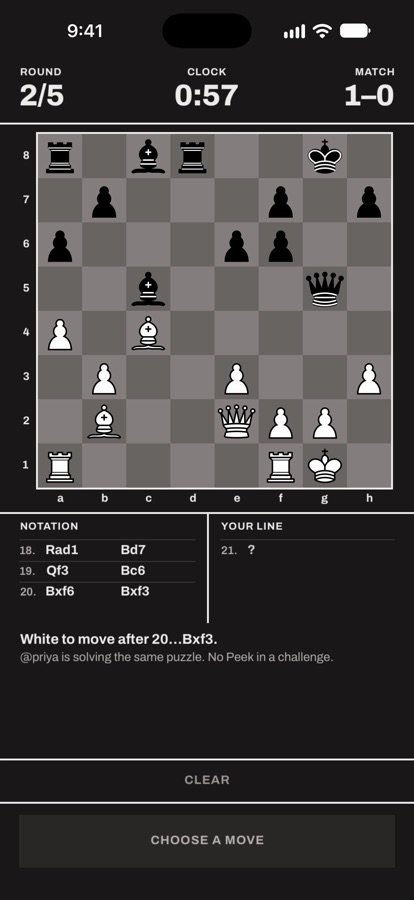
Real chess puzzles from Lichess, with a twist: the board is three full moves behind the notation. Play those moves in your head, then find the best move in a position you can’t see.
- 01
Read
The board shows the game six half-moves before the puzzle. The notation lists those moves: three by White, three by Black.
- 02
Play them in your head
Pieces move and pieces are taken, but the board stays exactly as it was drawn.
- 03
Find the move
Pick the piece’s square and its target on the board you see, then play the best move. A wrong move ends the puzzle.
- Puzzles
- Real puzzles from the Lichess puzzle database, and the moves before each one from its own game
- Ranked
- Puzzles near your rating, never one you’ve had before. Each puzzle has a rating too, and both move
- Casual
- A puzzle streak that climbs from 500 by 75 each, on a 5-minute, 10-minute or untimed clock, until your first miss or peek
- Challenge
- Live rounds against a friend on the same puzzles: 1, 3, 5 or 7 of them, with 30 seconds, 1 minute or 2 minutes a puzzle, or no limit
- Trains
- Visualization, calculation, memory
From the iPhone app
Four games, one app
The real screens.
The animations above recreate each game’s rules. These are the games as they run on iPhone.
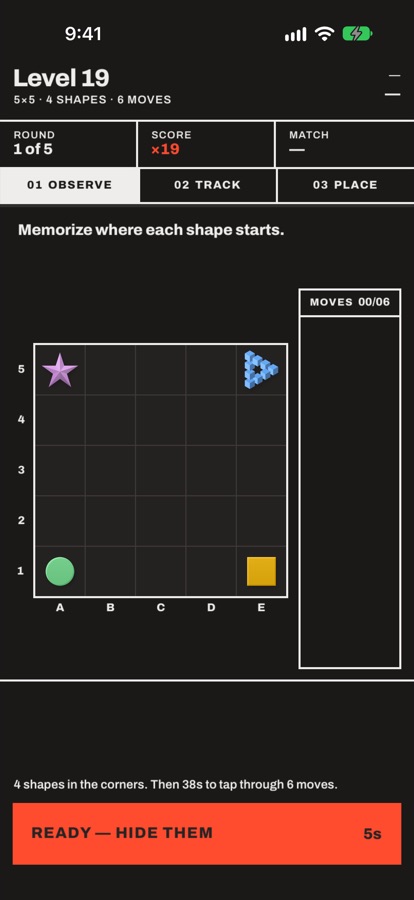
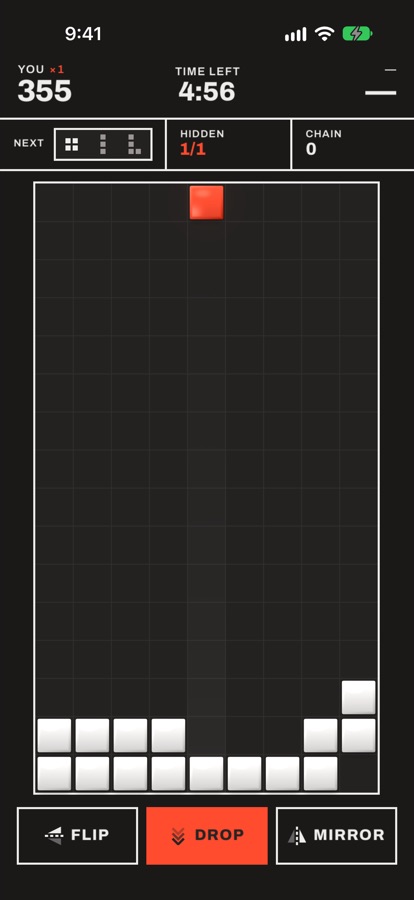
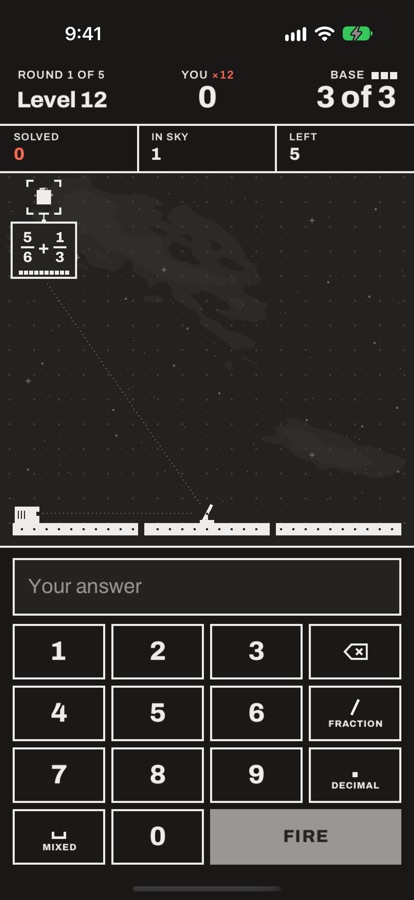
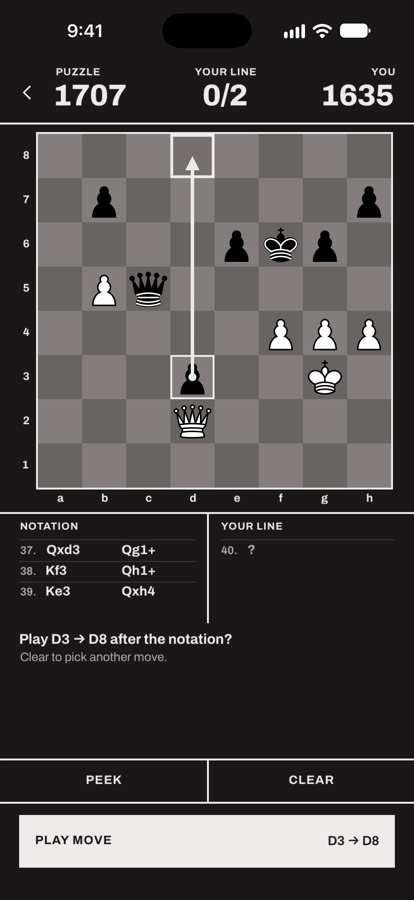
All four games in one free app.
Three free losses a day. Wins and draws never count.

Head to head
Same puzzle. Real opponent.
Grid, Stack and Math matches start in seconds at any hour, even while the player base is small. Each one is one of three kinds, picked in this order.
Live comes first. If nobody is searching at the same time, you get a real player’s recorded game. If there isn’t one yet, you play solo and the result is settled later against real players.
Both at once
Both players play the same content at the same moment and see each other’s progress as it happens.
A real player’s game
You play against another player’s recorded game, on the same puzzles, replayed against your clock.
Play once. Face five.
A solo game is settled against the next five players who get the same rounds.
Chess Puzzles
Chess Puzzles skips matchmaking. In a challenge, two friends solve the same puzzles at the same moment. In Ranked and the streak, you play the puzzles themselves.
Same puzzle, live
One to seven rounds against a friend. Solve a puzzle the other misses for a point. Level on points, the faster solver wins.
Rated both ways
Every puzzle has its own rating. Solve it or miss it, and both ratings move: yours and the puzzle’s.
Race the clock
Puzzles climb from 500 by 75 each until your first miss or peek, with 5 minutes, 10 minutes or no clock.
For investors and partners
Business model
How PhantomBrain grows.
PhantomBrain is live on both stores and earns from one product, PhantomBrain Premium. Players start free with three losses a day. Premium removes the limit, and nothing else is for sale: no ads and nothing that helps anyone win.
At a glance
- Status
- Live on the App Store and Google Play
- Revenue
- PhantomBrain Premium, $4.99 a month or $24.99 a year
- Free plan
- All four games, with three losses a day
- Ads
- None
- Fair play
- Every puzzle served and every answer checked on the server
- Matches
- Live, async or solo, so a game starts in seconds at any hour
- Contact
- contact@gentlebits.net
From free player to Premium member
Three ways it grows
Members bring friends in free
A challenge or rematch from a Premium member never costs the other player a loss, so paying players pull free players into games.
Creators bring audiences
New players name the creator who sent them, and partners are rewarded when those players buy Premium.
Ready at any player count
Live, async and solo matches start in seconds at any hour, even while the player base is small, and a chess puzzle needs no opponent at all.
Platform
How it’s built
Two native apps. One server.
PhantomBrain is built natively for each phone. One server deals every puzzle, runs matchmaking and ratings, and scores every game, so both apps play by one set of rules.
Swift, SwiftUI and SpriteKit. All four games, live and async play, friends and Game Center, notifications and subscriptions.
Kotlin and Jetpack Compose. All four games, on the same server and under the same rules, with Google sign-in.
One server
Shared by bothRust and PostgreSQL. Matchmaking, ratings, every puzzle and piece sequence, the Lichess puzzle library, scoring from each player’s inputs, notifications and subscriptions.
Partners
For creators
We thank the partners who bring new minds to the game.
Why it matters
From the app’s Welcome screen
“In this respect the brain is like a muscle. When we think well, we feel good. Understanding is a kind of ecstasy.”
Get the game.
Four brain games, free on iPhone and Android. Lose up to three games a day, and win as many as you can.
The game animations on this page illustrate each game’s real rules with real puzzle content, and the example day is an illustration of the free plan. The screens are from the iPhone app. Chess Puzzles plays puzzles from the Lichess puzzle database (CC0); the one animated here is 6mSBC. Chess pieces by Colin M.L. Burnett, under the BSD licence. App Store is a service mark of Apple Inc. Google Play is a trademark of Google LLC.